| This map is found on Mapicurious.com | Download these points of interest directly into your favorite GPS or other geo software | |||
|
|||
| Use the zoom controls on the map to adjust the map's viewable area then print: | |||

| LOCATIONS highlighted on this map: |
|
lat:34.71186667 
Fred Dover constructed a bridge and nearby grist, saw and shingle mill complex here in the late 1800s. The original bridge washed away in the early 1890s and Will Pardue replaced it in 1895 with the present 38-foot structure. Dover sold the operation to Fred Stovall, Sr. in 1917. The mill and dam washed away in 1964. Constructed as a modification of the queen post truss design, the bridge's trusses have two vertical posts (with iron rods) separated by a horizontal crosspiece. The bridge was featured in the 1951 movie, "I'd Climb the Highest Mountain", starring Susan Heyward.
lat:34.73653 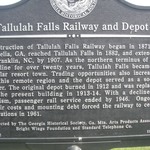
Construction of Tallulah Falls Railway began in 1871 at Cornelia, GA, reached Tallulah Falls in 1882, and extended to Franklin, NC, by 1907. As the northern terminus of the rail line for over twenty years, Tallulah Falls became a popular resort town. Trading opportunities also increased for this remote region and the depot served as a social center. The original depot burned in 1912 and was replaced by the present building in 1913-14. With a decline in tourism, passenger rail service ended by 1946. Ongoing repair costs and mounting debt forced the railway to cease operations in 1961.
lat:34.3242333333333 From the mill's construction in 1930 , students under the supervision of a miller used the Old Mill to produce corn meal and food stuffs for the Berry Schools. The Republic Mining and Manufacturing Company donated the iron hub, while students built the water wheel. At 42 feet in diameter, this is one of the nation's largest overshot waterwheels. Berry's reservoir lake supplies water to the wheel. Gravity pushes water up the stone column and over the wheel, turning it. The Old Mill has been preserved as a testament to the practical training Martha Berry incorporated into her schools.
lat:34.7810333333333 Renowned Appalachian poet, novelist, and farmer, Byron Herbert Reece lived most of his life near this site. Here he composed, to critical acclaim, four volumes of poetry and two novels, Better a Dinner of Herbs and The Hawk and the Sun. Reece was a five-time recipient of the Georgia Writers Association?s literary achievement award and was nominated for a Pulitzer Prize in poetry for Bow Down in Jericho. He served as poet-in-residence at the University of California at Los Angeles , Emory University , and Young Harris College . Suffering from tuberculosis, Reece took his own life three months before his forty-first birthday. He is buried in Old Union Cemetery near Young Harris.
lat:34.270746 At this house's core is the 1790s log home of Major Ridge (c.1771-1839), a leader in the Cherokee Nation. His 223-acre plantation supported numerous outbuildings, orchards and slaves while the family served as ferryboat operators and merchants. It was here the council negotiated the Treaty of New Echota in 1835, which promised the Cherokees land compensation for voluntarily moving to Oklahoma. Their forced removal became known as the "Trail of Tears." Ridge knew death was imminent for selling tribal lands but believed the treaty to be the only means to save his people. He, his son, and nephew were murdered in 1839.
lat:34.2678333333333 Thomas E.G. Ransom enlisted as captain of Company E, 11th Illinois Volunteer Infantry in 1861. Wounded four times, he won honors at Ft. Donelson, Shiloh, Vicksburg, and Red River. Rising steadily through the ranks, Ransom led the 17th Corps, Army of The Tennessee in the Battle of Jonesboro severing the last railroad into Atlanta. His infantry then pursued Confederate General John B. Hood northward. Stricken with typhoid fever, Ransom died here at the home of John Berryhill on October 29, 1864. He was breveted Major General posthumously and is buried in Rose Hill Cemetery in Chicago.
lat:34.414026 The Georgia Marble Company began in 1884 as one of many small marble quarrying operations in the region. In 1905 Colonel Sam Tate became the company’s president, continuing in that position until his death in 1938. Georgia Marble Company stone can be found in monuments and public buildings around the world, including the Lincoln Memorial and the twenty-four columns on the east front of the U.S. Capitol in Washington, D.C. As the Village of Tate’s largest employer, Georgia Marble Company provided housing, recreational facilities, and schools for workers and their families. Construction of a company power plant made Tate the first electrified town in the area.
lat:34.7697666666667 On April 19, 1864, General Joseph E. Johnston reviewed the Confederate Army of Tennessee on this ridge. After his appointment in December 1863, Johnston rebuilt a defeated and demoralized army following Confederate General Braxton Bragg's defeat at the Battle of Missionary Ridge in November 1863. When Union General William T. Sherman began to advance on Dalton, Confederate troops moved into defensive positions. On May 13, 1864, Johnston's troops evacuated Dalton to defend Resaca, and the Atlanta Campaign was underway. This was the last grand review of the Army of Tennessee and came on the eve of Sherman's campaign to capture Atlanta and the subsequent March to the Sea.
lat:34.7612833333333 John B. McCarty began laying out a neighborhood here in 1928. By 1950, influential Dalton residents had established one of the city’s earliest subdivisions using New South landscaping. Tudor Revival, Colonial Revival, and Minimal Traditional architectural styles popular in Georgia at the time. This neighborhood housed residents who pioneered and maintained the Dalton textile and carpet industry whose products are used world-wide. McCarty himself was founder of Dalton Spread Laundry, a key business in the evolution of the carpet industry.
lat:34.47015 This 38-foot monument was designed and dedicated in 1930 by Colonel Sam Tate of Georgia Marble Company, as a tribute to General James Edward Oglethorpe, founder of the colony of Georgia. Attendees included Governor Lamartine G. Hardman and other prominent dignitaries. It was carved by James Watt from Cherokee marble quarried locally. These quarries are the largest in the United States. The monument was located 10 miles east on Mount Oglethorpe (Grassy Knob), southern terminus of the Appalachian Trail until 1958. It was restored and moved here in 1999. |


|
Although the author has taken all reasonable care in preparing this guide, Mapicurious and the author make no warranty about the accuracy or completeness of its content and accept no responsibility for any loss, injury, or inconvenience arising from its use. |